Radon Testing Requirements by State: A Complete 2026 Guide

Understanding Radon Testing Requirements Across the United States
Radon is the second leading cause of lung cancer in the United States, responsible for approximately 21,000 deaths each year according to the EPA. This colorless, odorless radioactive gas seeps from the ground into homes through cracks in foundations, gaps around pipes, and other entry points. While the federal government recommends radon testing for all homes, state-level requirements vary dramatically — from comprehensive testing mandates to minimal regulation.
If you're a homeowner, home buyer, or real estate professional, understanding your state's specific radon testing requirements can save you money, protect your health, and ensure legal compliance during property transactions. This guide breaks down what you need to know about radon testing laws, when testing is required, and how to find certified professionals in your area.
Why Radon Testing Matters Everywhere
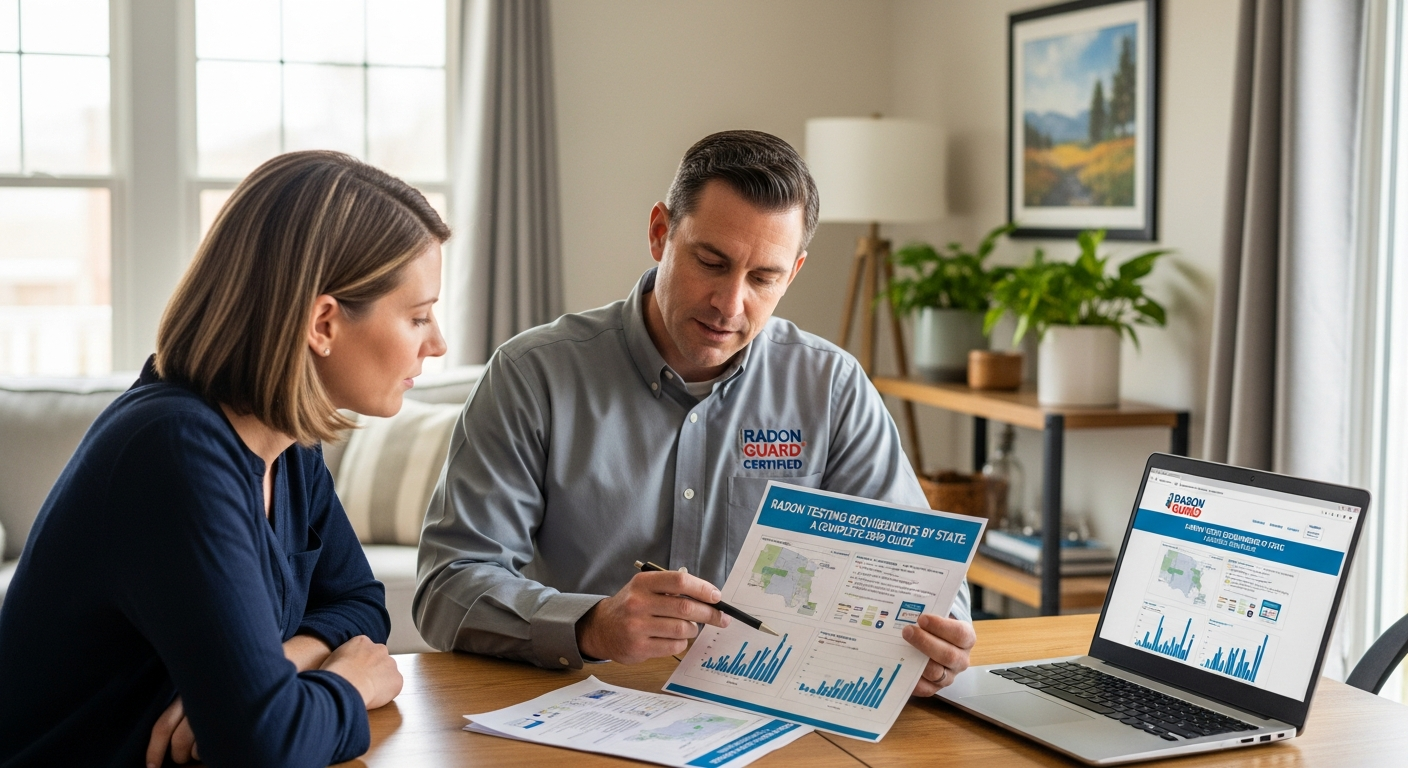
Before diving into state-specific rules, it's important to understand that radon is a nationwide problem. The EPA estimates that 1 in 15 U.S. homes has elevated radon levels at or above the action level of 4 pCi/L (picocuries per liter). The agency also recommends considering mitigation for levels between 2-4 pCi/L, as no level of radon exposure is truly "safe."
While certain states like Pennsylvania, Iowa, and parts of the Mountain West have higher average concentrations due to geological factors, elevated radon has been found in every state — including in homes located in EPA Zone 3 (predicted low-risk) areas. This is why testing is the only way to know your home's actual radon level, regardless of where you live.

Federal Framework: The Baseline for All States
At the federal level, radon testing is not legally required for most residential transactions. However, several federal frameworks influence state and local rules:
- EPA Guidelines: The EPA strongly recommends testing all homes below the third floor and provides protocols for short-term and long-term testing.
- HUD Requirements: The Department of Housing and Urban Development requires radon testing for certain multifamily properties financed with HUD-insured loans.
- FHA and VA Loans: While not universally required, some FHA and VA mortgage transactions may involve radon disclosure or testing in high-risk areas.
- Federal Buildings: Schools, federal facilities, and certain government-funded housing developments often face testing requirements.
State laws build on this federal foundation in widely varying ways. Let's examine the major categories of state regulation.
States with Strong Radon Testing Requirements
A handful of states have enacted robust radon testing and disclosure laws. These typically apply to real estate transactions, rental properties, schools, or daycare facilities.
Illinois
Illinois has one of the most comprehensive radon disclosure laws in the country. Under the Illinois Radon Awareness Act, sellers must provide buyers with the EPA's "Radon Testing Guidelines for Real Estate Transactions" and a disclosure form indicating whether the home has been tested. If testing was conducted, the results must be shared. All radon professionals operating in Illinois must be licensed through the Illinois Emergency Management Agency (IEMA).
Florida
Florida law requires radon disclosure in all real estate transactions. Sellers and landlords must provide a specific notice informing buyers and tenants that radon is a naturally occurring radioactive gas that may pose health risks. Florida also requires radon measurement businesses to be certified by the Florida Department of Health.
New Jersey
New Jersey requires radon testing for all real estate transactions in designated Tier 1 (high-risk) municipalities. Additionally, the state mandates testing for all child care centers and schools. Testing must be conducted by certified professionals registered with the New Jersey Department of Environmental Protection.
Maine
Maine requires landlords to test rental properties for radon every 10 years and to provide test results to tenants. Sellers must also disclose any known radon test results to potential buyers. Maine's strong stance reflects the state's elevated radon risk in many regions.
Minnesota
The Minnesota Radon Awareness Act requires sellers to disclose radon test results and provide buyers with the Minnesota Department of Health's radon publication before closing. Licensed radon professionals must be registered with the state.
Pennsylvania
While Pennsylvania doesn't require radon testing for residential sales, it does require certification of all radon testers and mitigators through the Department of Environmental Protection. Given that Pennsylvania has some of the highest radon levels in the nation, testing is strongly recommended and commonly performed during real estate transactions.
States with Disclosure-Only Requirements
Many states require sellers to disclose known radon information without mandating actual testing. These typically include:
- Connecticut: Sellers must disclose known radon test results and any mitigation work.
- Indiana: Disclosure required on the state's property condition form.
- Iowa: Sellers must disclose known radon information; Iowa has the highest average indoor radon levels in the country.
- Kansas: Property disclosure form requires radon information.
- Massachusetts: Disclosure required; certification programs administered by state.
- Michigan: Property disclosure includes radon section.
- New Hampshire: Disclosure required for known radon issues.
- Ohio: Sellers must disclose known radon test results; certified professionals required for testing in real estate transactions.
- Rhode Island: Disclosure and licensed mitigation required.
- West Virginia: Disclosure required on property condition form.
In these states, what you don't know, you don't have to disclose — but once you test and discover elevated levels, you typically must report this to future buyers.

States with Minimal or No Specific Requirements
Several states have minimal radon-specific real estate requirements, though general "material defect" disclosure laws may still apply. These states include parts of the South and West where radon awareness has historically been lower, though radon levels can still be elevated in individual homes regardless of state policy.
Even in states without specific mandates, most professional home inspectors and real estate agents recommend radon testing during purchase transactions. Lenders may also require testing for certain loan products, and buyers can — and should — include radon testing contingencies in their purchase contracts.
School and Daycare Testing Requirements
A growing number of states require or strongly recommend radon testing in schools and child care facilities. States with school testing mandates or formal recommendations include:
- Colorado: Required for licensed child care facilities
- Connecticut: Required for public schools
- Florida: Required for licensed child care facilities and schools
- Illinois: Required for licensed child care facilities
- Iowa: Required for accredited public and nonpublic schools
- New Jersey: Required for schools and child care centers
- Rhode Island: Required for schools and day care facilities
- Virginia: Required for licensed child day centers
If you're a parent, school administrator, or daycare operator, check your state's specific rules — testing may be required on a recurring schedule (often every 5 years).
Real Estate Transactions: What to Expect
Whether or not your state requires radon testing, here's what typically happens during a real estate transaction:
For Buyers
- Request a radon test as part of your home inspection contingency. Standard short-term tests run 2-7 days.
- Use a certified professional — look for NRPP (National Radon Proficiency Program) or NRSB (National Radon Safety Board) certification.
- Review results carefully. If levels are at or above 4 pCi/L, negotiate mitigation with the seller.
- Consider re-testing after mitigation to confirm levels have been reduced below the action level.
For Sellers
- Disclose any known test results — required in most states and ethically important everywhere.
- Consider testing before listing to address issues proactively rather than under time pressure.
- Hire a certified mitigator if elevated levels are found. Professional mitigation typically costs $800-$2,500 and is highly effective.
- Keep documentation of all testing and mitigation work for future buyers.
For Real Estate Agents
Stay current on your state's specific disclosure requirements, as failing to provide required notices can expose you to liability. Many states require agents to provide buyers with the EPA's "Home Buyer's and Seller's Guide to Radon."
Understanding Test Results and Action Levels
Once you have your test results, here's how to interpret them based on EPA guidelines:
| Radon Level | EPA Recommendation |
|---|---|
| Below 2 pCi/L | No action required; consider periodic re-testing |
| 2-4 pCi/L | Consider mitigation, especially in living areas |
| 4 pCi/L and above | Action level — mitigation strongly recommended |
| 10 pCi/L and above | Immediate action recommended |
It's worth noting that the World Health Organization recommends an even lower action level of 2.7 pCi/L, and many radon professionals advise mitigation at any level above 2 pCi/L given the lack of a true "safe" threshold.
Testing Methods and Timing
Radon levels fluctuate based on weather, season, and home conditions. The EPA recognizes several testing approaches:
Short-term tests (2-90 days): These use charcoal canisters, alpha track detectors, or continuous radon monitors. Results are quick but may not capture annual averages.
Long-term tests (more than 90 days): These provide a better picture of year-round exposure but take longer to deliver results.
Continuous radon monitors (CRMs): Used by most certified professionals during real estate transactions, these provide hour-by-hour data and are tamper-resistant — important for transaction integrity.
For real estate transactions, most states and lenders accept a properly conducted short-term test (typically 48 hours) performed by a certified professional under "closed building conditions."
Why Certification Matters
Whether your state requires it or not, hiring a certified radon professional ensures:
- Accurate testing protocols following EPA standards
- Proper device calibration and quality assurance
- Tamper-resistant procedures during real estate transactions
- Proper mitigation system design if elevated levels are found
- Legal compliance in states requiring certification
The two main national certification bodies are:
- NRPP (National Radon Proficiency Program) — administered by AARST
- NRSB (National Radon Safety Board)
Some states also maintain their own licensing programs that may include additional requirements beyond national certification.
What to Ask a Radon Professional
When hiring a tester or mitigator, ask:
- Are you certified by NRPP or NRSB?
- Are you licensed in this state (if applicable)?
- What type of testing device will you use?
- How will you ensure closed building conditions?
- Can you provide references or sample reports?
- What is your protocol if elevated levels are found?
- Do you offer both testing and mitigation, or testing only?
For maximum objectivity during real estate transactions, some experts recommend using separate companies for testing and mitigation to avoid potential conflicts of interest.
Common Misconceptions About State Requirements
"My state doesn't require testing, so my home is safe." False. State regulations reflect political priorities, not geological reality. Radon has been found at elevated levels in every state.
"New homes don't need testing." False. Even homes built with radon-resistant construction techniques should be tested after completion to confirm the systems are working.
"I tested years ago, so I'm done." False. The EPA recommends re-testing every two years, after major renovations, or after any changes to your home's ventilation or foundation.
"Radon is only a basement problem." False. While radon often enters through the lowest level, it can accumulate throughout the home. Test the lowest livable level of your house.
Taking Action: Your Next Steps
Regardless of your state's specific requirements, protecting your family from radon exposure is one of the most cost-effective health investments you can make. A basic short-term test costs $15-$25 if you do it yourself, or $150-$300 if performed by a certified professional. Compare that to the lifetime risk of lung cancer, and the math is clear.
Here's your action plan:
- Check your state's specific requirements through your state radon program or environmental agency.
- Determine your home's radon zone using the EPA's interactive map.
- Schedule a test — either DIY or through a certified professional.
- Review results against EPA action levels.
- Mitigate if needed using a certified contractor.
- Re-test every 2 years or after major home changes.
For real estate transactions specifically, don't skip the radon contingency even in states that don't require it. The cost is minimal compared to the value of knowing what's in the air your family breathes.
Find a Certified Radon Tester Near You
Whether your state mandates testing or not, every home deserves to be tested for radon. Don't let geography determine your family's health.
Ready to find a certified radon professional in your area? Visit FindRadonTesters.com to connect with NRPP and NRSB certified testers and mitigation specialists in your state. Our nationwide directory makes it easy to compare local professionals, read reviews, and schedule testing — so you can protect your home and family with confidence.
Don't wait for a real estate transaction to think about radon. Test your home today.