Pennsylvania Radon Levels: Highest-Risk Counties & Homeowner Guide

Why Pennsylvania Has Some of the Highest Radon Levels in the Nation
Pennsylvania consistently ranks among the top states in the U.S. for elevated indoor radon levels — and the data is striking. According to the Pennsylvania Department of Environmental Protection (DEP), roughly 40% of homes tested in the Commonwealth have radon levels at or above the EPA's action threshold of 4 pCi/L. To put that in perspective, the national average sits closer to 1.3 pCi/L, and only about 1 in 15 homes nationwide exceed the action level. In Pennsylvania, the ratio is closer to 2 in 5.
The reason comes down to geology. A massive band of uranium-rich rock known as the Reading Prong stretches across the eastern and central parts of the state. As uranium naturally decays underground, it produces radium, and radium decays into radon — an invisible, odorless, radioactive gas that seeps up through soil and bedrock and accumulates inside homes. Because radon is the second-leading cause of lung cancer in the United States behind smoking, where you live in Pennsylvania matters more than you might realize.
This guide walks through the highest-risk counties, the geological factors that drive elevated readings, and what homeowners and home buyers should do about it.

The EPA's Radon Risk Zones in Pennsylvania

The U.S. Environmental Protection Agency divides every county in the country into one of three radon zones:
- Zone 1 (Highest Risk): Predicted average indoor radon screening level greater than 4 pCi/L
- Zone 2 (Moderate Risk): Predicted average between 2 and 4 pCi/L
- Zone 3 (Lowest Risk): Predicted average less than 2 pCi/L
Here is the sobering reality for Pennsylvania: every single one of the state's 67 counties is classified as Zone 1 or Zone 2. There are no Zone 3 (low-risk) counties anywhere in the Commonwealth. The vast majority — more than 50 counties — fall into Zone 1, meaning the predicted average indoor radon level is above the EPA action level.
This is why radon testing in Pennsylvania is not an optional precaution. It is a baseline part of responsible homeownership, regardless of whether you live in a brand-new build or a 200-year-old farmhouse.
The Reading Prong: Pennsylvania's Radon Engine
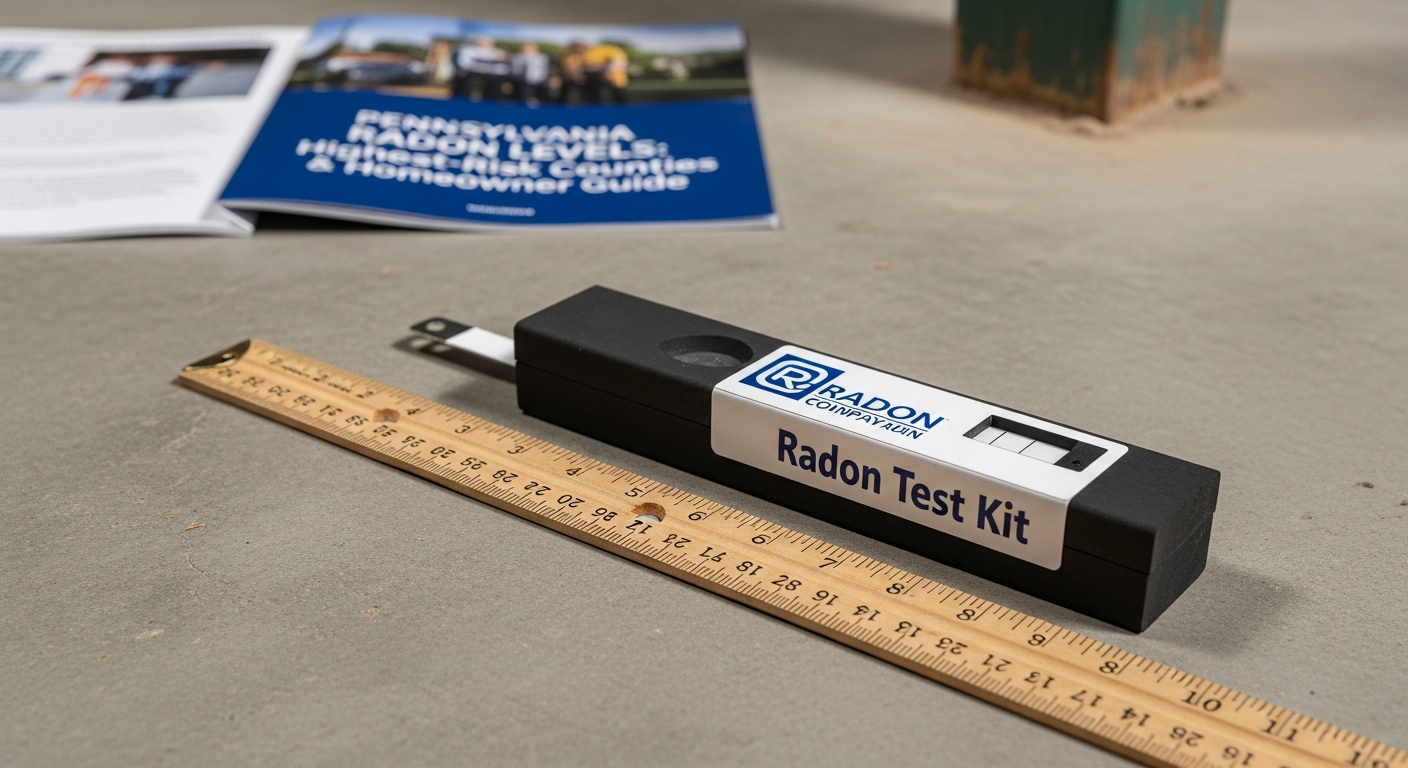
The single most important geological feature driving Pennsylvania's radon problem is the Reading Prong, a band of Precambrian gneiss and granitic rock that runs roughly from Reading, PA, through the Lehigh Valley and into northern New Jersey and the Hudson Highlands of New York.
The Reading Prong contains unusually high concentrations of uranium-bearing minerals. As that uranium decays through its natural radioactive chain, it produces radium-226, which in turn produces radon-222. The fractured, faulted nature of the rock allows radon gas to migrate upward toward the surface, where it enters homes through:
- Cracks in basement floors and foundation walls
- Construction joints
- Gaps around service pipes
- Cavities inside walls
- Sump pits and floor drains
- Well water (in some cases)
It was actually a Reading Prong worker — Stanley Watras, an engineer at the Limerick Nuclear Generating Station — whose contaminated home in Boyertown in 1984 first alerted the EPA to the scope of the residential radon problem. His home tested at over 2,700 pCi/L, the equivalent of smoking hundreds of packs of cigarettes a day.
Highest-Risk Counties in Pennsylvania
While the entire state warrants attention, several counties consistently report the highest average and peak radon readings. If you live in or are buying a home in any of these areas, testing should be considered essential, not optional.
Berks County
Berks County sits at the heart of the Reading Prong and is widely regarded as ground zero for Pennsylvania's radon problem. Average indoor screening levels here are among the highest in the country, and individual homes have tested at hundreds — even thousands — of pCi/L. The Boyertown, Kutztown, and Oley Valley areas in particular have a long history of extreme readings.
Chester County
Chester County combines Reading Prong geology in its northern and western reaches with rapidly expanding suburban housing stock. Areas like Phoenixville, Kennett Square, and West Chester routinely produce homes well above 4 pCi/L. Because of high housing turnover and Pennsylvania's strong disclosure norms, radon testing during real estate transactions is common here.
Montgomery County
Montgomery County straddles a transition between the Reading Prong and the Triassic Lowlands. The northwestern portion of the county — Pottstown, Limerick, and points north — tends to produce the highest readings, though elevated levels appear throughout the county. Older homes with stone foundations and uncovered basement floors are particularly prone to high indoor concentrations.
Lehigh and Northampton Counties
The Lehigh Valley sits squarely on the Reading Prong's path. Allentown, Bethlehem, Easton, and the surrounding townships consistently report county averages above 4 pCi/L. Both counties are also home to a large number of mid-century homes with poured concrete basements, which can develop micro-fractures over time that allow radon entry.
Bucks County
The northern and central portions of Bucks County are particularly affected, with Doylestown, Quakertown, and the Upper Bucks region producing many readings well above the action level. Like Chester County, radon testing during home sales is the norm rather than the exception.
Lancaster County
Lancaster's geology is dominated by limestone and dolomite — both of which are excellent radon producers and pathways. The county's karst topography, with its underground voids and channels, can funnel radon directly into homes. Lancaster, Lititz, and Ephrata are among the higher-reading communities.
York and Adams Counties
South-central Pennsylvania, including York and Adams counties, sits on a mix of limestone, schist, and metamorphic rock that produces consistently elevated readings. These counties also have a high concentration of older farmhouses with stone or rubble foundations, which provide easy radon entry points.
Centre County
Home to State College and Penn State, Centre County's limestone geology contributes to elevated readings throughout the region. Many homes in the Nittany Valley test above the action level, and the area has a robust radon mitigation industry as a result.
Northern Tier Counties
Counties like Susquehanna, Wyoming, Lycoming, and Bradford — particularly in areas of active or historical natural gas drilling — have produced elevated readings as well. The Marcellus Shale formation contains uranium-bearing minerals that contribute to radon in both indoor air and well water.

Why Some Homes Test Higher Than Their Neighbors
One of the most counterintuitive aspects of radon is that two houses on the same street can have dramatically different readings. A home testing at 22 pCi/L might sit next door to one testing at 2 pCi/L. This happens because indoor radon concentration depends on a combination of factors:
- Foundation type: Basements typically test higher than slab-on-grade or crawl space homes. Stone, rubble, or block foundations leak more than poured concrete.
- Soil permeability: Sandy or gravelly soil allows radon to move freely. Clay soils slow it down — but if there's a path of least resistance into your home, it will find it.
- HVAC and ventilation patterns: Modern, tightly sealed homes can trap radon, while older drafty homes sometimes dilute it. However, energy-efficient retrofits frequently raise radon levels in formerly "safe" homes.
- Sub-slab conditions: Old French drains, sump pits, utility chases, and cracks all serve as entry points.
- Weather and season: Radon levels typically rise in winter when the "stack effect" pulls soil gas up into heated homes, and during periods of low barometric pressure.
This is why testing is the only way to know your home's actual radon level. EPA zone maps tell you the regional risk, but they cannot predict your specific home.
When and How to Test Your Pennsylvania Home
The Pennsylvania DEP and the EPA recommend the following testing cadence:
- Initial test for every home, regardless of age or foundation type.
- Retest every 2 years, or after any significant renovation, foundation work, HVAC change, or weatherization project.
- Always test before buying a home in Pennsylvania — and consider requiring a long-term (90+ day) test if the seller's short-term result is borderline (between 2 and 4 pCi/L).
Short-Term vs. Long-Term Tests
- Short-term tests (2 to 7 days) are useful for quick screenings, real estate transactions, and post-mitigation verification. They are typically charcoal or electret ion chamber devices.
- Long-term tests (90 days to a year) provide the most accurate picture of your year-round average radon exposure, since levels fluctuate significantly with weather and seasons.
DIY Kits vs. Certified Professional Testing
Drugstore DIY kits can give you a rough sense of your home's radon level for $15 to $30. However, they require careful placement, undisturbed test conditions, and prompt mailing to a lab — and they are not appropriate for real estate transactions in Pennsylvania.
For home sales, mitigation verification, or any situation where the result will drive a financial or health decision, hire a certified radon professional. In Pennsylvania, radon testers must be certified by the Pennsylvania DEP, and most are also credentialed through the National Radon Proficiency Program (NRPP) or the National Radon Safety Board (NRSB) — the two nationally recognized certifying bodies. Certified professionals use calibrated continuous radon monitors that record hourly readings, detect tampering, and produce defensible reports.
What to Do If Your Home Tests High
Here is the EPA's guidance based on test results:
- At or above 4 pCi/L: Take action. Have a certified radon mitigation contractor install a mitigation system.
- Between 2 and 4 pCi/L: Consider taking action. There is no "safe" level of radon; the World Health Organization sets a more conservative action level of 2.7 pCi/L. Many homeowners choose to mitigate in this range.
- Below 2 pCi/L: Retest every 2 years. Radon levels can change over time as homes settle, soil shifts, and HVAC systems are modified.
What Mitigation Looks Like
The most common mitigation method — active sub-slab depressurization — involves drilling through the basement slab, installing a PVC pipe that runs through the home (or up the exterior), and adding a continuously running fan that pulls soil gas from under the foundation and vents it safely above the roofline. A well-designed system typically reduces radon levels by 80% to 99% and costs $1,200 to $3,000 in most Pennsylvania markets.
Crawl space homes, slab-on-grade homes, and homes with high radon in well water require different approaches, including sub-membrane depressurization, aeration treatment for water, or hybrid systems. A certified mitigation contractor will diagnose your home and recommend the right design.
After mitigation, always retest within 30 days to confirm the system is working — and then retest every 2 years to make sure it continues to perform.
Special Considerations for Home Buyers in Pennsylvania
If you are buying a home in Pennsylvania, radon testing should be part of your inspection contingency — not an afterthought. Pennsylvania's Real Estate Seller Disclosure Law requires sellers to disclose known radon test results, but many sellers have never tested. A failure to disclose does not mean a home is safe; it usually just means no one has checked.
Key tips for buyers:
- Hire an independent NRPP- or NRSB-certified tester rather than relying on the seller's test.
- Use a continuous radon monitor for a minimum 48-hour test under closed-house conditions.
- If the result is above 4 pCi/L, negotiate mitigation as part of the purchase agreement. Sellers in Pennsylvania are generally accustomed to this request, and mitigation is straightforward.
- If the result is between 2 and 4 pCi/L, consider asking for a longer-term test or planning to mitigate after closing.
- For new construction, ask whether the home was built with radon-resistant new construction (RRNC) techniques — passive sub-slab piping that can be activated with a fan if needed.
Special Considerations for Renters
Renters in Pennsylvania have fewer protections than homeowners, but landlords are required to disclose known radon test results above 4 pCi/L. If you rent in a high-risk Pennsylvania county and have never seen a radon test result, ask your landlord directly. You can also conduct your own test — most short-term kits work fine in rented units.
Don't Wait — Test Your Home This Season
If you live in Pennsylvania, the question is not whether you should test for radon. It is when. With every county in the state in a moderate- or high-risk EPA zone, and with 4 in 10 homes already known to exceed the action level, testing is one of the highest-value health investments a homeowner can make. Mitigation is affordable, effective, and well-established. The only step that is missing for most families is the test itself.
Whether you need a real estate transaction test, a routine biennial check, or post-mitigation verification, working with a certified professional gives you confidence in the result.
Ready to test your home? Visit FindRadonTesters.com to connect with NRPP- and NRSB-certified radon testers in your Pennsylvania county. Get a fast, reliable test from a qualified local pro and take the guesswork out of one of the most important health decisions you can make for your household.