EPA Radon Zones Explained: What Your County's Color Really Means

Understanding EPA Radon Zones: What Every Homeowner Needs to Know
Radon is an invisible, odorless radioactive gas that seeps up from the soil and into homes across America. It's the second leading cause of lung cancer in the United States, claiming approximately 21,000 lives each year according to the Environmental Protection Agency (EPA). To help homeowners, builders, and public health officials understand where radon risk is highest, the EPA created a national mapping system known as EPA Radon Zones.
If you've ever wondered why your county is shaded red, orange, or yellow on a radon map — or whether your zone designation means your home is automatically safe or unsafe — this guide breaks it all down. Understanding your EPA Radon Zone is the first step toward protecting your family from a serious but entirely manageable health risk.

What Are EPA Radon Zones?
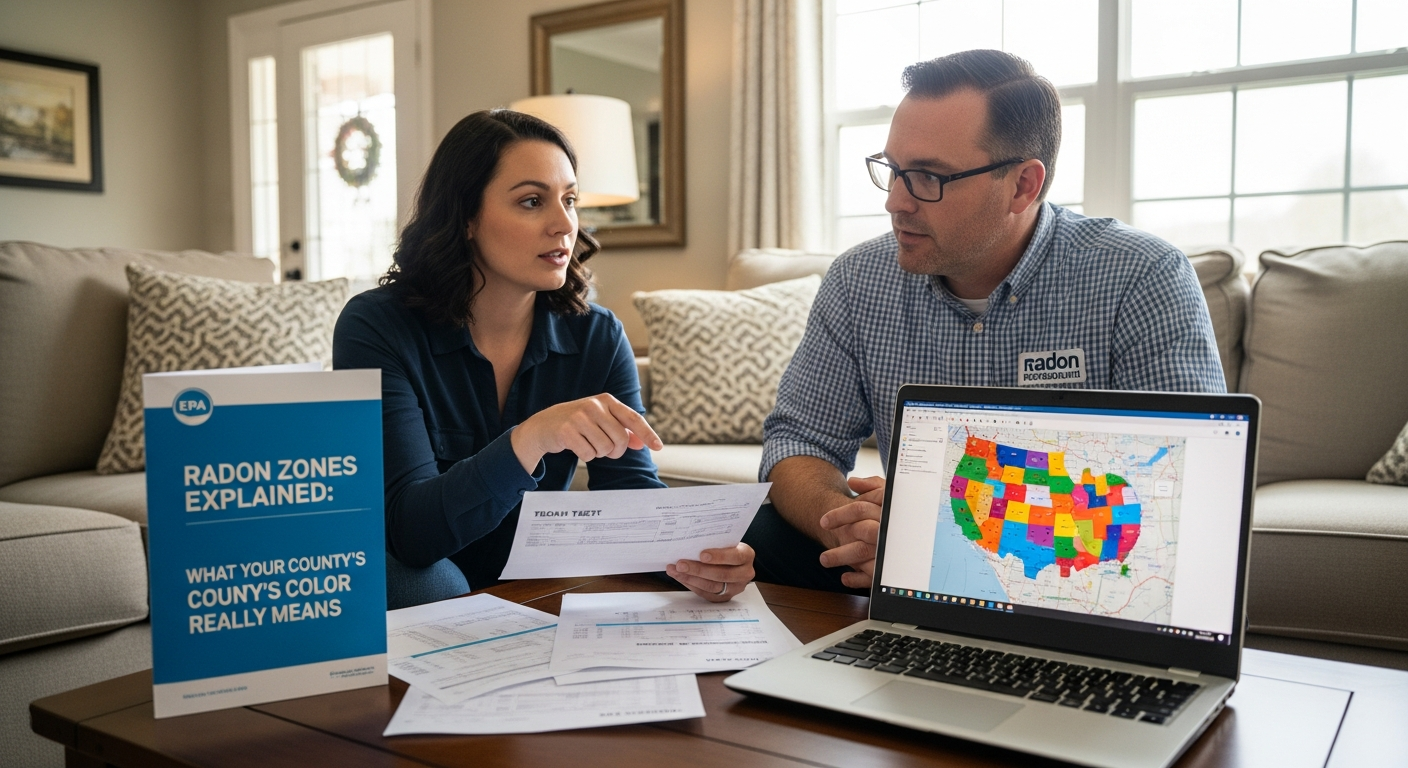
In 1993, the EPA partnered with the U.S. Geological Survey (USGS) and state radon programs to develop the Map of Radon Zones. The goal was to help governments, builders, and homeowners identify areas where the average indoor radon level is likely to be elevated — and where radon-resistant new construction (RRNC) techniques should be prioritized.
The map divides every county in the United States into one of three zones based on the predicted average indoor radon screening level:
- Zone 1 (Red): Highest potential. Predicted average indoor radon screening level is greater than 4 pCi/L (picocuries per liter of air).
- Zone 2 (Orange): Moderate potential. Predicted average indoor radon screening level is between 2 and 4 pCi/L.
- Zone 3 (Yellow): Lowest potential. Predicted average indoor radon screening level is less than 2 pCi/L.
These thresholds align directly with EPA's well-known guidance:
- 4 pCi/L is the EPA's action level — homes testing at or above this should be mitigated.
- 2–4 pCi/L is the "consider action" range — the EPA recommends considering mitigation, especially for families with smokers, children, or other vulnerable individuals.
How Were the Zones Determined?
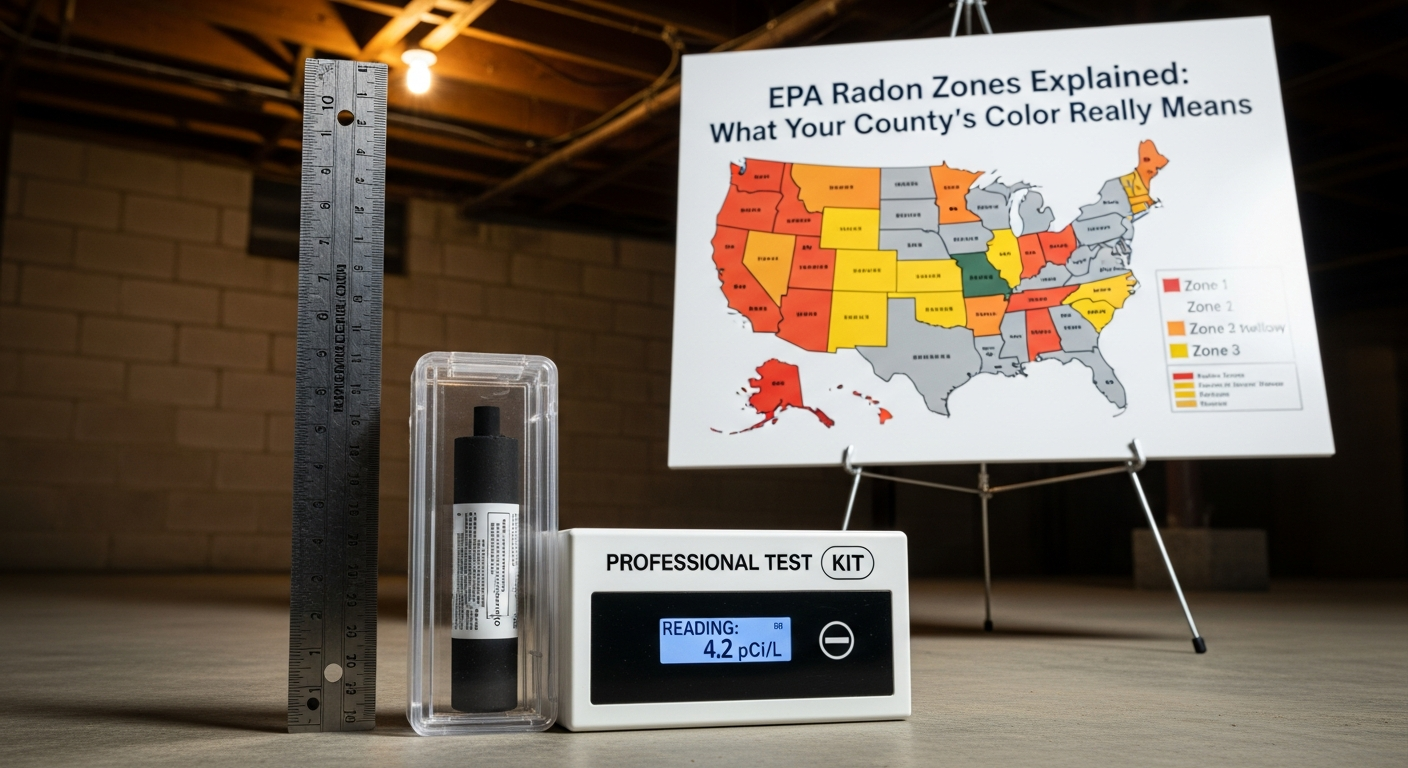
The EPA used a combination of data to assign zones to each of the more than 3,000 counties in the U.S., including:
- Indoor radon measurement data from previous testing programs
- Geologic information, such as bedrock type, soil permeability, and uranium content
- Aerial radiometric data collected by the USGS
- Soil characteristics, including how easily air and gas move through them
- Foundation type prevalence in the area (basements vs. slab-on-grade, etc.)
These factors were weighted and combined to produce a predicted average screening measurement for each county. It's important to understand that this is a predictive map based on regional geology and historical data — not a measurement of your specific home.
A Critical Caveat: Zones Don't Tell You About Your Home
This is the single most important thing to understand about EPA Radon Zones:
Your home's radon level cannot be predicted by your county's zone designation alone.
The EPA explicitly states that "homes with elevated levels of radon have been found in all three zones." Radon levels can vary dramatically from one house to the next — even between neighbors on the same street. Factors that influence indoor radon levels include:
- Foundation type and condition (cracks, sump pits, crawlspaces)
- Soil composition directly under the home
- Construction materials (especially certain types of stone or concrete)
- HVAC system design and operation
- Weather patterns (radon levels often rise in winter when homes are sealed)
- Occupant behavior (window opening, ventilation habits)
- Well water sources (radon can be released from water during showering)
This means a home in Zone 3 ("low potential") can still have dangerously elevated radon levels, while a home in Zone 1 may test below the action level. The only way to know your home's radon level is to test it.
A Tour Through the Zones: Where Risk Is Highest
While radon can be found anywhere, certain regions of the U.S. consistently show higher concentrations due to underlying geology.
Zone 1 — High Potential Counties
Zone 1 counties stretch across large portions of:
- The Upper Midwest: Iowa, Minnesota, Nebraska, North Dakota, South Dakota, and Wisconsin
- The Appalachian Region: Pennsylvania, West Virginia, Virginia, Kentucky, and Tennessee
- The Mountain West: Colorado, Montana, Idaho, and northern New Mexico
- The Great Plains: Kansas and parts of Oklahoma
- The Northeast: Maine and parts of New Hampshire
Iowa is notable for having every single one of its 99 counties classified as Zone 1 — the only state where this is true. This is largely due to glacial deposits left during the last Ice Age that contain elevated uranium concentrations.
Zone 2 — Moderate Potential Counties
Zone 2 counties form a transitional band and include large portions of:
- The Mid-Atlantic states
- Parts of the Southeast (northern Georgia, parts of the Carolinas)
- Sections of the Pacific Northwest
- Pockets across Texas, Arizona, and California
Zone 3 — Low Potential Counties
Zone 3 counties tend to cluster along:
- The Gulf Coast (Louisiana, southern Mississippi, southern Alabama, much of Florida)
- The Pacific Coast (parts of California, Oregon, and Washington)
- Coastal regions of the Southeast and Northeast

Why the Zones Matter (Even With Their Limitations)
Even though EPA Radon Zones can't tell you what's happening in your specific home, they serve several important purposes:
1. Guiding Building Codes
Many state and local jurisdictions in Zone 1 counties have adopted radon-resistant new construction (RRNC) requirements in their building codes. These passive systems — including a layer of gas-permeable aggregate, vapor barriers, sealed foundation openings, and a vertical vent pipe — can be activated with a fan to mitigate radon if elevated levels are detected after construction.
2. Real Estate Disclosure
Some states require radon disclosure during real estate transactions, and the disclosure requirements are often stricter in Zone 1 areas. If you're buying or selling a home in a high-risk zone, expect radon testing to be a standard part of the inspection process.
3. Public Health Outreach
State radon programs concentrate education, free or discounted test kit programs, and mitigation assistance grants in higher-risk zones. If you live in Zone 1 or 2, check with your state radon office — many offer free or low-cost test kits to homeowners.
4. Lender and Insurance Awareness
Some lenders and insurance companies factor radon risk into their decisions on properties in Zone 1 counties, particularly for FHA, VA, and USDA loan programs that may have specific radon testing requirements.
What Your Zone Means for Action
Here's a practical breakdown of what each zone designation should prompt you to do:
If You Live in Zone 1
- Test your home immediately if you haven't already
- Retest every 2 years even after a clean initial test
- Test after major home renovations, foundation work, or HVAC changes
- Insist on radon testing as part of any home purchase
- Consider passive mitigation during any new construction or major remodel
If You Live in Zone 2
- Test your home — moderate-zone homes frequently exceed the action level
- Retest every 3-5 years after an initial clean test
- Don't skip testing during real estate transactions
If You Live in Zone 3
- Test your home anyway — radon doesn't respect map boundaries
- Don't assume safety based on your zone — elevated levels exist in every county type
- Test after any major foundation work or basement finishing project
How to Test Your Home for Radon
There are two main approaches to radon testing:
Short-Term Testing (2–7 days)
Short-term tests are inexpensive ($15–$30 for a DIY kit) and provide a quick snapshot of radon levels. They're commonly used in real estate transactions where time is short. Common types include:
- Charcoal canisters
- Alpha track detectors (short-term variant)
- Electret ion chambers
- Continuous radon monitors (CRMs)
Long-Term Testing (90+ days)
Long-term tests provide a much more accurate picture of your home's average radon level because they account for seasonal and weather-related fluctuations. The EPA recommends following up a short-term test above 4 pCi/L with either a second short-term test or a long-term test.
Professional Testing
For real estate transactions, new construction, or post-mitigation verification, the EPA strongly recommends hiring a certified professional. Look for testers certified by:
- NRPP (National Radon Proficiency Program), administered by AARST
- NRSB (National Radon Safety Board)
These certifications require coursework, exams, ongoing continuing education, and adherence to strict testing protocols. A certified tester will use calibrated equipment, follow chain-of-custody procedures, and provide a defensible report — critical if results will be used in a real estate negotiation or legal context.
Understanding Your Test Results
Once you have your results, here's how to interpret them:
| Result | EPA Recommendation |
|---|---|
| Below 2 pCi/L | No action required. Consider retesting every 2-5 years. |
| 2 to 3.9 pCi/L | Consider mitigation, especially for sensitive occupants. Retest to confirm. |
| 4 pCi/L or higher | Take action. Mitigate to reduce levels. |
| 10+ pCi/L | Urgent action recommended. Schedule mitigation as soon as possible. |
Remember that there is no safe level of radon — risk decreases as levels decrease. The EPA's 4 pCi/L action level represents a practical threshold based on what mitigation systems can reliably achieve, not a safety threshold.
What If Your Levels Are High? Radon Mitigation Basics
If your test shows elevated radon, don't panic. Radon mitigation is a well-established, effective technology. Most homes can be successfully mitigated to below 2 pCi/L for $1,200 to $2,500 depending on home size and foundation type.
The most common technique is active soil depressurization (ASD) — a vent pipe is installed through the foundation slab with an in-line fan that continuously draws radon-laden air from beneath the home and exhausts it above the roofline before it can enter the living space.
Other techniques include:
- Sub-membrane depressurization for crawlspaces
- Block wall depressurization for hollow concrete block foundations
- Sealing and improved ventilation as supplementary measures (not standalone solutions)
Always hire an NRPP or NRSB certified mitigation contractor for installation. Certified mitigators understand local building codes, proper fan sizing, electrical safety requirements, and post-installation testing protocols. A poorly installed system can fail to reduce radon — or worse, create new safety hazards related to backdrafting combustion appliances.
Common Misconceptions About EPA Radon Zones
Let's clear up some of the most persistent myths:
Myth 1: "My county is Zone 3, so I don't need to test." False. Elevated radon homes exist in every zone. The zone is a regional prediction, not a home-specific measurement.
Myth 2: "My neighbor tested low, so my home is fine." False. Two homes 50 feet apart can have radically different radon levels due to foundation differences, soil variation, HVAC operation, and dozens of other factors.
Myth 3: "New homes don't have radon problems." False. New construction can actually have higher radon levels because modern homes are more tightly sealed. Only homes built to RRNC standards (with passive systems installed) have meaningful built-in protection.
Myth 4: "Radon zones get updated regularly." The EPA's official Map of Radon Zones hasn't been comprehensively revised since 1993, though state and local data has continued to accumulate. Always supplement zone information with your state's radon program data and recent local testing trends.
Finding Your Zone and Taking Next Steps
To find your county's EPA Radon Zone:
- Visit the EPA's radon zone map online
- Check with your state radon office for state-specific maps that are often more granular
- Contact your local health department for neighborhood-level data and free test kit programs
Once you know your zone, the next step is the same regardless of where you fall on the map: test your home.
Don't Let an Invisible Threat Go Unmeasured
Radon is unique among home health hazards — it's deadly, but it's also entirely manageable once identified. Testing is inexpensive, mitigation is effective, and the technology has been refined over decades. The hardest part is simply taking the first step.
Whether you live in a Zone 1 hotspot or a Zone 3 coastal community, you owe it to your family to know your home's radon level. EPA Radon Zones are a useful planning tool, but they are no substitute for measurement — and they are certainly no guarantee of safety.
Ready to Test Your Home?
Don't leave your family's health to chance. Find a NRPP or NRSB certified radon professional in your area today on FindRadonTesters.com — our directory connects you with qualified, certified testers and mitigators who know your local zone, your local geology, and exactly what it takes to keep your home safe.
Search by ZIP code, compare certified pros, and book your radon test in minutes — because peace of mind shouldn't wait.